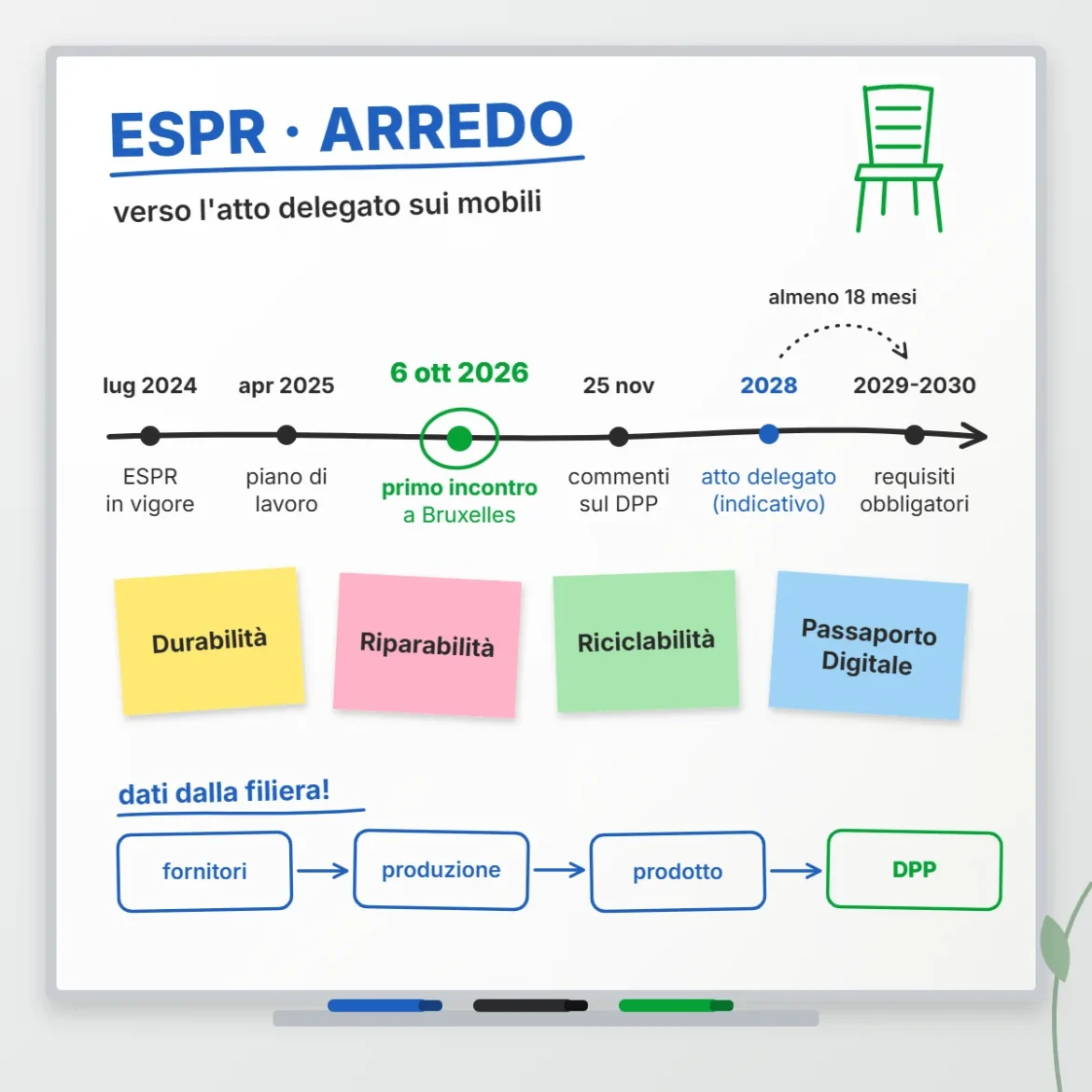
On 6 October the team working for the European Commission presented stakeholders with the first drafts of the ESPR preparatory study on furniture. The delegated act is expected in 2028, but the data it will require need to be built now, across the entire supply chain.
For European furniture, the Ecodesign Regulation is no longer a distant horizon. On 6 October, at the Albert Borschette Conference Centre in Brussels, the first stakeholder meeting of the ESPR preparatory study on furniture took place: the technical work from which the mandatory design requirements for furniture sold in the EU will emerge. The meeting was open to companies, associations and experts, in person or online. Among the participants was Marco Capellini Studio, registered as a stakeholder.
A day on the first drafts
The discussion focused on the results of Phase I of the study, the stage that maps the sector before deciding what to regulate. The team followed the European Ecodesign methodology (MEErP): first the scope, that is which products will fall within the definition of furniture, then the market, how furniture is used and discarded, and the technologies and materials available.
The afternoon was devoted to the first life cycle assessment (LCA) results and to the so-called base cases, the typical products against which the room for improvement will be measured. The day closed with a dedicated session on the Digital Product Passport.
The same study will also be used to revise the EU Ecolabel criteria for furniture. Its stated objectives are four: durability, reparability, recyclability and material efficiency. The drafts are public and companies can comment on them: there is time until 10 November for the first parts of the study and until 25 November for the assessment of the Digital Product Passport.
Why ESPR is targeting furniture
Furniture was already on the priority list written into the ESPR itself. The 2025-2030 working plan, adopted by the Commission on 16 April 2025, scheduled it alongside textiles, steel, aluminium, tyres and mattresses, with the delegated act expected to be adopted in 2028.
The reasons come down to one figure and one feature of the product. The sector is worth around EUR 140 billion in Europe, according to the 2021 figure quoted by the Commission. And in furniture most environmental impacts come not from use but from the production and supply of materials: wood and panels, metals, padding, fabrics, varnishes and glues. Different materials, often assembled in ways that are hard to separate, which at end of life are more likely to end up in landfill or incineration than in a new cycle.
Requirements still to be written, but the direction is clear
What the delegated act will require is not yet known: the study exists precisely to establish which requirements make sense and at what thresholds. The objectives set out by the team, however, outline the scope. The discussion will cover how long a piece of furniture should last, how easy it should be to repair and disassemble, how to separate its materials at end of life and how many resources it takes to make.
Then there is information. The study has devoted a specific assessment to the content of a possible Digital Product Passport for furniture. The Commission points out that inclusion in the working plan does not automatically make the passport mandatory: the study will determine whether it is the right tool. For furniture makers, though, the message has already landed: they will need to document the composition, origin and characteristics of their products, and much of that data comes from suppliers.
The next ESPR steps for furniture
At least three years will pass between the first meeting and the obligations. The delegated act is expected in 2028 and, after adoption, companies will have at least 18 months to comply. Dates from 2028 onwards are indicative and may change, including with the mid-term review of the working plan scheduled for 2028.
The real issue: supply chain data
Data is where the game will be played. “In the furniture companies we work with, there are two main difficulties,” explains Marco Capellini. “The first is obtaining information from the supply chain. The second is setting up an internal operational plan that brings ecodesign principles into the design process.”
On this front the studio is already working in the field. Together with Matrec, Marco Capellini Studio supports several furniture companies in measuring the circularity of their products and in collecting and tracing information along the supply chain: the same kind of data that the future delegated act, and a possible digital passport, will require to be made available.
There is time to prepare, but not much
At least 18 months will pass between the adoption of the delegated act and the obligations. It sounds like a wide margin, but for a furniture company it means involving many suppliers, revising technical data sheets and rethinking products under development. Collections designed today will still be in the catalogue when the requirements come into force.
That is why it pays to act on three fronts. First, understand where you stand today, with an ESPR Gap Analysis of your products against durability, reparability and recyclability. Second, measure circularity with recognised methods, such as UNI/TS 11820 and ISO 59020, to have verifiable figures instead of claims. Third, organise the collection of supplier data now, which is the longest part of the work.
If you want to understand where to start, contact us: the first step is a review of your products against the future ESPR requirements.

